

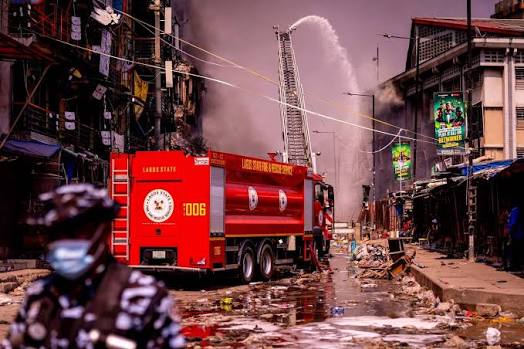
Lagos State recorded an estimated ₦13.24 billion in property losses from 1,135 fire outbreaks between January and September 2026, highlighting growing concerns over fire safety and the protection of residential and commercial properties across the state.
Figures from the Lagos State Fire and Rescue Service (LSFRS) show that the agency handled 1,324 emergency incidents during the nine-month period, while property valued at approximately ₦79.44 billion was saved through its firefighting and emergency response operations.
The emergencies also resulted in significant human casualties, with 210 people rescued alive and 65 bodies recovered during response operations.
The figures underscore the economic and social consequences of fire outbreaks, particularly in densely populated markets, warehouses, industrial facilities and commercial centres where incidents can destroy valuable assets, disrupt business activities and threaten livelihoods.
Lagos Expands Firefighting Infrastructure
In response to the growing need for improved emergency services, the Lagos State Government has expanded its firefighting infrastructure, increasing the number of fire stations from 14 in 2019 to more than 29 in 2026.
Additional fire stations are under construction in Yaba, Ikotun and Oworonshoki to improve emergency response coverage across the state.
The government has also deployed modern firefighting equipment, including fire engines, water tankers, rapid intervention vehicles and a hydraulic ladder platform designed to support emergency operations in high-rise buildings.
Efforts to strengthen the workforce have also continued, with 685 firefighters recruited between 2019 and 2026, while another 150 personnel received training at the upgraded Fire Academy.
According to the Controller-General of the Lagos State Fire and Rescue Service, Margaret Adeseye, the agency responded to 10,931 fire incidents, conducted 916 rescue operations and carried out 599 salvage missions between 2019 and 2026.
During the period, the service rescued 1,715 people and protected property valued at more than ₦658.86 billion.
Government Strengthens Fire Safety Measures
Beyond emergency response, Lagos State is increasing its focus on fire prevention through safety inspections, certification and public awareness programmes.
In 2025, the Lagos State Fire and Rescue Service inspected 8,791 facilities and issued 7,997 fire safety certificates to establishments that met the required standards.
The inspected facilities included companies, hotels, restaurants, schools, filling stations, hospitals, shopping malls and banking premises.
The state is also deploying Market Safety Marshals and volunteers through its Fire Marshal Programme to identify potential fire hazards, encourage compliance with safety regulations and support evacuation procedures in markets, schools, offices and residential communities.
Property owners and business operators have also been urged to maintain functional fire extinguishers, alarms and sprinkler systems while ensuring that emergency exits and access routes remain unobstructed.
Technology to Support Future Fire Prevention
As part of its long-term strategy, the fire service plans to introduce technology-driven solutions to improve emergency preparedness and response.
Adeseye disclosed that the agency’s 2026–2030 strategic plan includes artificial intelligence-powered fire risk mapping, smart firefighting equipment, a dedicated Fire Academy and the establishment of a Marine Fire Response Unit.
The plan also provides for the digitisation of emergency response operations to improve coordination, identify high-risk locations and support the effective deployment of firefighting resources.
The proposed Marine Fire Response Unit is expected to strengthen emergency protection around Lagos waterways, ports and coastal facilities.
Fire Safety Remains Critical to Property Protection
The latest figures highlight the importance of strengthening fire prevention measures across residential, commercial and industrial properties.
For property owners, developers and investors, fire outbreaks can result in substantial financial losses, structural damage, business interruptions and, in severe cases, loss of lives.
Small business operators and traders without adequate insurance coverage are particularly vulnerable, as a single incident can destroy years of investment and working capital.
The expansion of firefighting infrastructure and improved emergency response capacity therefore remain important to protecting property, supporting business continuity and creating safer urban environments.
As Lagos continues to experience rapid urbanisation and commercial expansion, sustained investment in fire prevention, building safety compliance and public awareness will be essential to reducing property losses and protecting lives.