

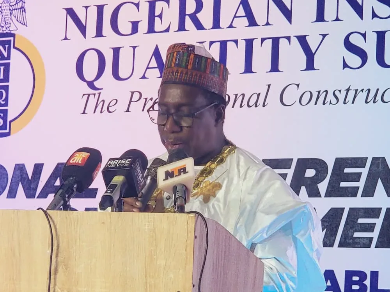
The Nigerian Institute of Quantity Surveyors (NIQS) has called for sustainable housing financing, effective construction cost management and increased investor confidence to address Nigeria’s estimated 15 million-unit housing deficit.
The institute’s President, Dr Aminu Bashir, said tackling the housing crisis required more than increasing the number of houses built, stressing the need to ensure that completed homes were affordable and accessible to ordinary Nigerians.
Bashir made the remarks on Wednesday during the opening ceremony of the 2026 NIQS National Conference and Annual General Meeting (AGM) in Ilorin, Kwara State.
The conference was themed, “Financing Sustainable Mass Housing: Synergising Cost Management and Capital Markets for Affordable Shelter in Nigeria.”
He identified high construction costs and limited access to long-term financing as major obstacles to delivering affordable mass housing across the country.
According to him, the housing deficit represents millions of families struggling to secure decent accommodation, including young Nigerians unable to enter the property market and workers whose incomes can no longer keep pace with rising housing costs.
The NIQS president explained that although efficient designs and effective project management could reduce construction expenses, housing projects would remain difficult to execute without adequate and affordable financing.
He cautioned, however, that access to investment capital alone would not guarantee affordable housing if construction costs were poorly assessed and projects inadequately managed.
Bashir noted that decisions involving building designs, feasibility studies, procurement methods, construction materials and financing arrangements played significant roles in determining the final cost of housing projects.
He stressed that quantity surveyors must be involved from the earliest stages of project development to ensure proper cost planning and management.
The institute’s president added that affordability should not be determined solely by the cost of constructing a building but by whether prospective beneficiaries could realistically purchase, occupy and maintain it.
He said this required greater attention to household incomes, land costs, infrastructure provision, mortgage terms and the long-term maintenance costs of buildings.
Bashir also called for improved construction productivity, increased use of appropriate locally sourced building materials and reduced material waste without compromising building safety and durability.
On housing finance, he welcomed the Nigeria Capital Market Masterplan 2.0 (2026–2036), describing it as an opportunity to mobilise long-term investments for housing and infrastructure development.
He identified housing bonds, Real Estate Investment Trusts (REITs), mortgage-backed securities and other financial instruments as potential mechanisms for closing the funding gap in the housing sector.
However, he stressed that investors required credible assurances that proposed projects were viable, construction estimates realistic, risks properly assessed and funds released in line with actual work completed.
He said the institute was advocating the integration of professional cost management into housing-finance arrangements, from project conception through construction to completion.
The NIQS president also expressed concern over the protection of prospective homebuyers, particularly those purchasing properties off-plan.
He announced that the institute’s Cost Data Bank was now available to provide reliable construction cost information and address the problem of inconsistent and unreliable cost estimates.
According to him, the initiative would strengthen budgeting, project planning and investment decisions while promoting transparency and efficiency in the construction industry.
Bashir further called for stronger partnerships among government agencies, capital-market institutions, property developers and construction professionals to accelerate mass housing delivery.
Meanwhile, the Acting Head of Service of Kwara State, Dr Olufunke Mercy Shittu, represented by Mr Haliru Hayatudeen, proposed several government-backed interventions to improve access to affordable housing.
She advocated housing and rent subsidies to reduce the financial burden on Nigerians struggling with rising accommodation costs.
Shittu also urged corporate organisations to channel their corporate social responsibility initiatives towards housing development, noting that such contributions could expand access to decent accommodation.
She proposed extending the Federal Government’s tax credit initiative to the housing sector to encourage greater investment and participation in affordable housing delivery.
The Acting Head of Service further called on the government to harness contributions to the National Housing Fund from both public and private sector participants to address the country’s housing challenges.
The NIQS conference is holding from November 16 to 20, 2026, in Ilorin, Kwara State. niqs.org.ng +2