

Lower-income households are increasingly being priced out of Lagos’ housing market as property prices continue to exceed what most earners can afford, according to research by GTI Investment Group’s Research & Strategy division.
The research, contained in GTI Research’s Beyond Rent: A Lagos Housing & Capital Report, estimates that Lagos requires about N6 trillion in fresh capital annually to keep pace with its housing deficit.
The report argues that the housing challenge is not simply about building more homes, but also involves capital allocation, affordability and access to housing finance, with a large share of new housing concentrated at price points beyond the reach of most households.
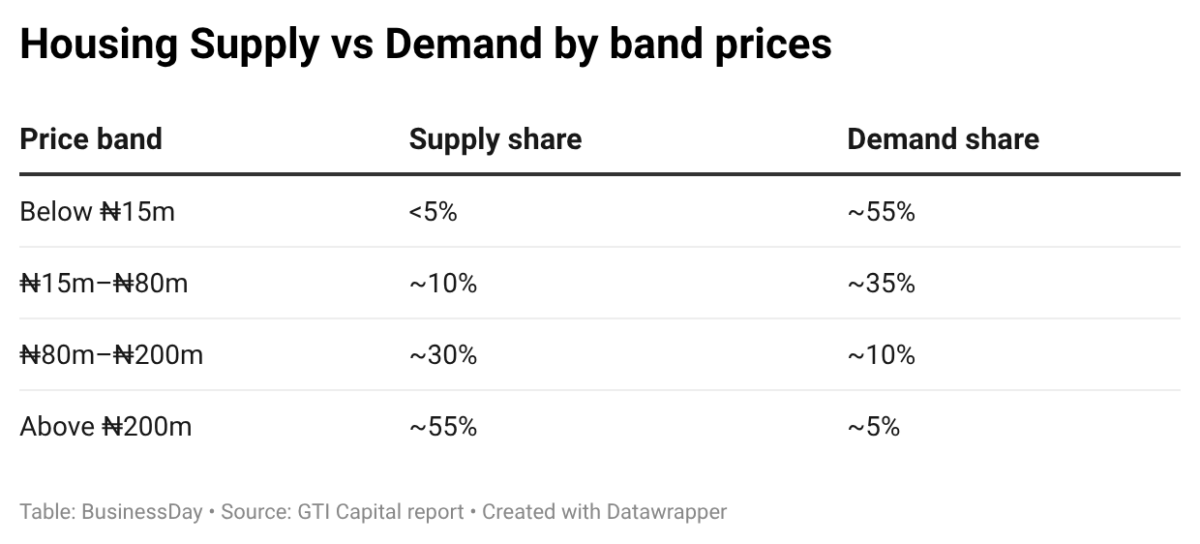
GTI’s analysis shows that properties priced below N15 million account for less than five per cent of housing supply but represent about 55 per cent of estimated demand.
Similarly, homes priced between N15 million and N80 million account for about 10 per cent of supply against roughly 35 per cent of demand.
At the upper end of the market, properties above N200 million make up about 55 per cent of supply but only five per cent of estimated demand.
The report noted that more than half of Lagos’ housing supply is therefore being developed for a relatively small segment of the market, while most demand remains concentrated at the lower end.
GTI described the situation as a lower-income finance exclusion problem rather than a universal affordability failure.
The findings come as housing costs continue to rise faster than household incomes. The research estimates that rents across Lagos increased by 80 to 120 per cent between 2024 and 2026, while wages increased by only seven to nine per cent during the same period.
As a result, 80.6 per cent of residents surveyed by GTI described housing in Lagos as severely unaffordable.
The affordability gap becomes more evident when the cost of homes is compared with what households can realistically finance.
Using a subsidised mortgage rate of 9.75 per cent, a 20-year tenor and a 10 per cent equity contribution, GTI estimates that low-income earners can afford property values of about N2.46 million.
Lower-middle-income earners can access properties ranging from approximately N2.5 million to N5.28 million, while middle-income earners have an estimated affordability range of N5.31 million to N17.59 million.
Upper-middle-income earners can support property values between N17.63 million and N52.77 million.
Against this backdrop, GTI said Nigeria’s official affordable-housing range of N15 million to N40 million remains largely inaccessible to lower-income households, even under subsidised mortgage conditions.
The report also puts Lagos’ property price-to-income ratio at 19.2 times, compared with 18.4 times in Cairo, 11.5 times in Nairobi, 5.4 times in Cape Town and 4.2 times in Durban.
A Lagos-based developer interviewed by GTI, identified as Mr Jarus, said affordability had become difficult even for relatively high-income workers.
He told researchers that he could not remember the last time someone in Nigeria bought a house from him, adding that even oil and gas workers earning between N3 million and N4 million monthly were struggling to afford decent properties.
N6trn annual capital requirement
GTI estimates that Lagos requires approximately N6 trillion in fresh capital every year to keep pace with its housing deficit.
The figure is about 2.6 times Lagos State’s N2.337 trillion 2026 capital budget, highlighting the scale of the financing gap confronting the housing market.
The research, based on more than 3,200 rental listings across four platforms, field surveys of commuter fares and infrastructure project data covering 15 zones across Lagos, argues that conventional public spending alone is unlikely to close the gap.
The report proposes four financing mechanisms that it estimates could collectively mobilise between N2.75 trillion and N3.85 trillion annually, equivalent to about 45 to 65 per cent of the identified capital requirement.
These include Micro-Title Regularisation, which GTI estimates could mobilise N150 billion to N250 billion annually by converting informal occupancy into mortgageable titles.
It also proposes a Lagos Infrastructure Value Capture Authority, which would use betterment levies and “Uplift Bonds” to capture part of the increase in land values created by public infrastructure. GTI estimates this could generate between N600 billion and N900 billion annually.
Another proposal is the Lagos Land Equity & Ground-Lease Trust, through which state-owned land could be converted into trust equity while retaining state ownership. GTI estimates annual mobilisation of N1.2 trillion to N1.5 trillion.
The fourth proposal is LaREIT, a proposed Lagos rental-equity real estate investment trust that would allow 15 to 20 per cent of rent paid by participating tenants to vest as housing equity without requiring a conventional mortgage.
GTI estimates LaREIT could mobilise between N800 billion and N1.2 trillion annually.
Housing being built for the wrong market
GTI’s analysis suggests that the affordability problem is closely linked to the structure of housing supply.
While demand is concentrated in lower-priced properties, developers are supplying a much larger share of homes at the upper end of the market.
The report estimates that properties above N200 million account for roughly 55 per cent of supply, despite representing only about five per cent of demand.
Conversely, homes below N15 million account for less than five per cent of supply despite representing approximately 55 per cent of demand.
The mismatch means that simply increasing the number of houses built may not significantly improve affordability if new supply continues to target households with substantially higher purchasing power.
GTI’s analysis therefore points to the need to redirect capital towards housing segments where demand is deepest.
Cheaper homes can come with higher costs
The report also argues that housing affordability cannot be assessed by rent alone.
GTI developed an Effective Rent Burden Matrix, combining annual rent and commuting costs to estimate the broader cost of living associated with different locations.
For a two-bedroom property, annual rent in Yaba is estimated at about N4.75 million, compared with roughly N3.1 million in Ajah.
However, annual dual-commute costs to Marina are estimated at about N526,000 for Yaba residents, compared with N1.15 million for Ajah residents.
Ajah residents also spend about 21 additional minutes per trip commuting to Marina, which GTI estimates translates into approximately 23 additional eight-hour working days spent in transit annually.
The report noted that lower headline rents in peripheral areas can therefore be offset by higher transportation and time costs.
Infrastructure reshaping property values
GTI’s analysis also identifies transport infrastructure as an increasingly important determinant of property values across Lagos.
Properties within the catchment of the Blue Line rail record gross rental yields of about six to seven per cent, compared with four to 4.5 per cent for comparable properties outside the catchment, according to the report.
GTI projects that the Red Line could support property price growth of 12 to 18 per cent in Yaba and 10 to 15 per cent in Ikeja through 2026.
It also estimates that properties within one to two kilometres of a rail station can command a 10 to 25 per cent value premium.
The report describes the Lekki-Epe corridor as having shifted from a congestion-driven pricing model towards what it calls “access-stabilised lifestyle pricing” as transport infrastructure improves.
It also identifies the Omi Eko water-transit project as potentially significant to the long-term reshaping of Lagos’ property geography.
Cement alone cannot solve affordability crisis
Despite the sharp increase in construction costs, GTI argues that cement prices alone do not explain Lagos’ housing affordability crisis.
The report estimates that the price of a 50kg bag of cement increased from about N2,500 in 2020 to between N11,500 and N15,000 in 2026.
However, GTI calculates that an 82 per cent reduction in cement prices, based on a comparison with Vietnam’s cement pricing, would reduce the total construction cost of a N25 million housing unit by about 14.76 per cent, equivalent to N3.69 million.
The research therefore points to land costs, approval charges, infrastructure deficiencies and financing constraints as other major contributors to housing costs.
GTI estimates that land consent, registration and delays under the Land Use Act can add N5 million to N10 million to a N50 million property.
It also estimates that Lagos State collected about N80 billion in building-approval charges in 2025, with charges of roughly N500,000 to N2 million per unit.
Rather than advocating full-scale liberalisation of cement imports, GTI proposes a Cement Price Concession for Affordable Housing, under which producers would supply designated affordable-housing projects at discounted prices in return for volume commitments and tax incentives.
Investment opportunities remain, but risks are high
For investors, GTI’s district-level analysis shows significant differences in rental yields across Lagos.
Ibeju-Epe and Yaba recorded the highest gross yields in its analysis, at about 1.86 per cent and 1.78 per cent respectively, while Ikoyi and Ikorodu recorded 0.87 per cent and 0.56 per cent.
The report describes Lekki Phase 1 as a mature market where much of the infrastructure premium has already been priced in.
It identifies Ajah, Sangotedo and Ibeju-Epe as a longer-term growth corridor linked to developments around the Lekki Deep-Sea Port and Free Trade Zone.
GTI estimates five-year cumulative price appreciation of 80 to 120 per cent in the Ibeju-Lekki corridor, 60 to 90 per cent around Red Line mainland nodes, 50 to 70 per cent in mainland legacy zones and 40 to 60 per cent in prime Island locations such as Ikoyi and Victoria Island.
However, the report cautions that infrastructure-led appreciation depends on actual project delivery, meaning anticipated corridor premiums can remain deferred when infrastructure projects are delayed.
GTI also highlights a significant yield gap for investors, putting the current net yield on Lekki Phase 1 property at about 3.2 per cent, compared with roughly 22 per cent on Nigerian Treasury bills.
Purpose-built student accommodation around Yaba, meanwhile, is estimated to generate yields of 10 to 12 per cent.
The report identifies land fraud, multiple sales, forged Certificates of Occupancy, revocation risks under the Land Use Act, naira volatility and uncertainty around infrastructure delivery among the key risks facing property investors.
It also flags lengthy foreclosure processes, which it says can take between two and three years, as a constraint on mortgage lending.
GTI recommends that financial institutions increasingly “finance corridors, not houses”, assessing property risk based on infrastructure, location and broader economic activity rather than relying solely on individual properties as collateral.
Climate risk is also identified as a longer-term concern, particularly because flood exposure overlaps with some of Lagos’ most valuable infrastructure and property corridors.
GTI’s central conclusion is that Lagos’ housing crisis cannot be solved simply by increasing construction.
The city needs a housing-finance system that connects land, infrastructure, mortgages, rental income and investment capital, while directing more capital towards the segments where demand is greatest.