

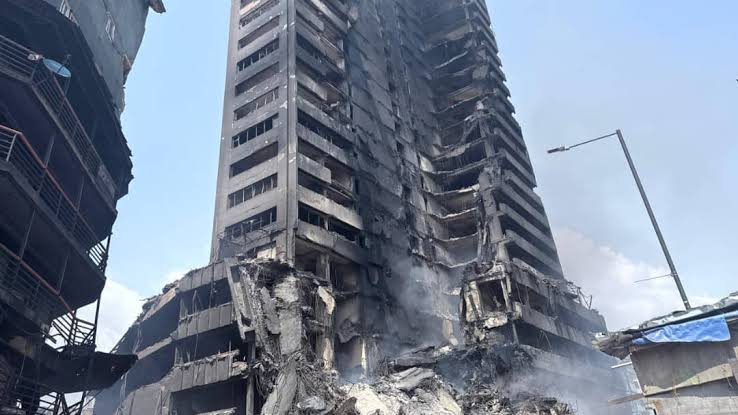
The Lagos State Government has confirmed the successful demolition of four floors of the fire-damaged Great Nigeria Insurance (GNI) House on Martins Street, Lagos Island, without recording any casualties or major damage to neighbouring properties.
The Lagos State Emergency Management Agency (LASEMA) disclosed that the controlled demolition exercise, which commenced on October 15, 2026, was progressing steadily, dismissing social media reports alleging that someone had fallen from the building during the operation.
The agency’s Permanent Secretary, Dr. Olufemi Damilola Oke-Osanyintolu, described the reports as false, stressing that no worker, trader, passerby, or emergency officer had been injured or lost their life since the exercise began.
He urged members of the public to disregard unverified information and rely on official updates from the agency.
Controlled Demolition Follows Strict Safety Procedures
According to LASEMA, the demolition is being executed through a controlled, top-down mechanical process, with the building dismantled gradually, floor by floor.
Oke-Osanyintolu explained that the approach allows engineers to monitor the structure continuously and make necessary adjustments throughout the operation, reducing the risk of an uncontrolled collapse in the densely populated commercial district.
He added that several safety measures had been introduced to protect workers, traders, residents and adjoining buildings.
These include restricted access to the demolition site, security cordons, traffic diversions, standby medical and emergency response teams, continuous dust suppression and mandatory use of personal protective equipment by workers.
The agency also confirmed that engineers are monitoring surrounding structures for possible vibrations or damage during the demolition.
Fire Disaster Prompted Demolition Order
The 25-storey Great Nigeria Insurance House was gutted by fire on December 24, 2025, in a disaster that claimed 12 lives and destroyed significant quantities of goods and property.
Following structural assessments that established the building had become a threat to public safety, Lagos State Governor Babajide Sanwo-Olu ordered its demolition.
The decision was aimed at eliminating the risks posed by the compromised structure to neighbouring buildings, traders, residents and other users of the area.
The demolition is therefore part of the government’s efforts to address the safety concerns created by the fire-damaged property and prevent further danger to the surrounding commercial environment.
Government Appeals to Balogun Market Traders
The ongoing exercise has resulted in temporary restrictions around the demolition site, affecting movement and commercial activities along Martins Street and parts of the Balogun Market area.
Addressing traders, Oke-Osanyintolu acknowledged the disruption caused by the restrictions but explained that the measures were necessary to protect lives and properties.
He reassured affected traders that the restrictions were intended to ensure public safety and not to work against their businesses.
The government, he added, remained committed to completing the demolition safely so that normal commercial activities could return to the area.
LASEMA also appealed to traders, residents and motorists to stay away from restricted areas, obey traffic diversion signs and follow instructions from emergency personnel.
Members of the public were advised to report safety concerns through the Lagos State emergency toll-free numbers 112 and 767.
Building Safety and Urban Risk Management
The demolition of the GNI House highlights the importance of structural safety assessments and effective emergency management, particularly in densely populated commercial districts.
Fire incidents involving high-rise buildings can extend beyond the immediate property, threatening adjoining structures, businesses, infrastructure and human lives.
The controlled removal of structurally compromised buildings is therefore an important part of managing post-disaster risks and protecting surrounding communities.
For Lagos, where commercial activities and high-density developments place significant pressure on urban infrastructure, effective coordination between emergency management agencies, building control authorities and other relevant institutions remains essential to maintaining safer urban environments.
The successful demolition of the four floors without casualties represents progress in the ongoing operation, with authorities maintaining that public safety remains the priority as work continues.