

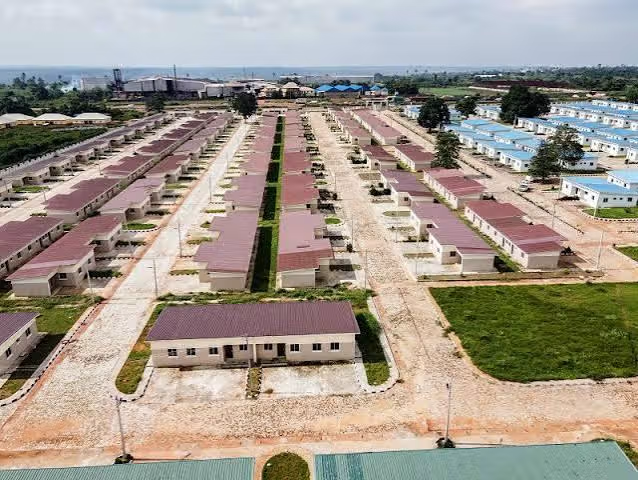
Nigeria’s housing crisis is forcing policymakers and industry players to reconsider one of the country’s biggest development challenges: whether the focus should remain on building more houses or on creating a financial system capable of making affordable housing available at scale.
With Nigeria’s population growing rapidly and urbanisation accelerating, demand for housing continues to outpace supply. The Federal Ministry of Housing and Urban Development recently put the country’s housing deficit at about 14.9 million units, while estimating that another 15.2 million existing homes are inadequate because they lack essential services or sufficient living space.
The figures point to a problem that goes beyond the number of houses being constructed.
Nigeria needs homes that people can afford, access to long-term financing and institutions capable of connecting developers, lenders, investors and prospective homeowners.
Nigeria’s housing challenge goes beyond construction
For years, housing discussions in Nigeria have largely focused on supply.
Governments have announced housing programmes, released land for development and partnered with private developers to construct estates across the country.
Yet homeownership remains difficult for millions of Nigerians.
Rising construction costs, inflation, expensive building materials, foreign exchange pressures, high interest rates and limited mortgage access have made the cost of delivering and purchasing homes increasingly challenging.
Land administration and infrastructure costs also add to the problem, while developers often struggle to access affordable long-term capital.
This creates a difficult cycle: developers need financing to construct affordable homes, while prospective buyers need affordable mortgages to purchase them.
Why housing finance is becoming central
Countries that have successfully expanded affordable housing have generally relied on more than direct government construction.
They have developed financial institutions and systems capable of mobilising long-term capital, reducing risks for investors and connecting public policy with private-sector investment.
Nigeria is increasingly moving towards a similar model.
Development finance institutions, mortgage providers, private developers and international financial organisations are playing a larger role in addressing different parts of the housing value chain.
The objective is gradually shifting from government acting primarily as a builder to government helping create an ecosystem in which affordable housing can be financed and delivered continuously.
FHFL’s changing role in Nigeria’s housing market
Family Homes Funds Limited (FHFL) has become one of the institutions operating within this emerging housing-finance ecosystem.
Established by the Federal Government to expand access to affordable housing finance, FHFL’s activities have increasingly extended beyond financing conventional residential developments.
Its interventions now cover areas including affordable mortgages, student accommodation, social housing, land preparation, infrastructure, artisan training and housing supply-chain development.
The broader strategy reflects the idea that housing development cannot be treated simply as the construction of buildings.
Land must be available and properly prepared. Infrastructure has to be provided. Developers need financing. Construction workers require skills. Buyers need mortgages they can afford.
When these elements work together, housing delivery becomes more sustainable.
Student housing becomes part of the solution
One area receiving increased attention is student accommodation.
Nigeria’s tertiary institutions continue to accommodate growing numbers of students, while purpose-built accommodation has struggled to keep pace with demand.
The resulting shortage can force students into overcrowded, expensive or poorly serviced accommodation outside their institutions.
FHFL’s National Student Housing Programme was launched to address part of this gap.
The programme commenced in 2025 with a plan to deliver 38,400 bed spaces across 24 tertiary institutions, backed by a commitment of more than ₦100 billion.
Beyond adding accommodation, such projects could create opportunities for private-sector participation in university housing while improving access, safety and affordability for students.
Mortgage access remains a major obstacle
Even where homes are available, many Nigerians struggle to purchase them because mortgage financing remains expensive or inaccessible.
High interest rates, large equity requirements and limited access to long-term funding can place homeownership beyond the reach of many first-time buyers.
FHFL’s Help-to-Own mortgage product, developed with support from the African Development Bank, is designed to address some of these barriers.
The programme seeks to make mortgage financing more accessible to first-time homeowners, while also expanding participation among women.
According to FHFL, women account for more than one-third of beneficiaries of the programme.
Housing can also drive economic development
The importance of housing extends beyond providing shelter.
Construction creates demand for cement, steel, furniture, logistics, professional services and other industries.
Every new housing development can therefore generate employment while creating opportunities for local businesses and increasing economic activity.
This makes housing investment a potential driver of broader economic growth.
For Nigeria, where youth unemployment, household incomes and rising living costs remain major concerns, an expanded housing sector could create economic opportunities across multiple industries.
Social housing meets economic empowerment
Another emerging approach is the integration of housing with livelihood support.
FHFL has implemented housing initiatives targeting vulnerable women, combining access to homes with vocational training, artisan development and business support.
The approach recognises that housing security alone may not be enough to improve household welfare.
Beneficiaries who receive skills and income-generating opportunities alongside housing may have a stronger capacity to maintain their homes and improve their economic circumstances.
FHFL says more than 200 vulnerable women in Kaduna, Calabar and Ibadan have benefited from training and empowerment initiatives under this approach.
The 15 million-home question
Despite these interventions, Nigeria’s housing deficit remains enormous.
No single institution or programme can close a gap approaching 15 million homes.
The more important question, therefore, is whether Nigeria can build a housing-finance system capable of continuously producing affordable homes rather than relying on isolated government projects.
That will require deeper mortgage markets, more efficient land administration, lower development costs, stronger public-private partnerships and greater access to long-term capital.
It will also require policies that make affordable housing commercially viable for developers while keeping repayment costs within the reach of ordinary households.
From building houses to building a housing system
This could represent a significant shift in Nigeria’s housing policy.
The traditional approach has often measured progress by the number of houses government constructs.
The emerging approach is broader: build the institutions, financing mechanisms, infrastructure and partnerships that allow affordable housing to be produced repeatedly and sustainably.
Institutions such as FHFL therefore represent more than individual housing projects. Their activities provide an indication of a housing strategy increasingly focused on building the market infrastructure required to deliver homes at scale.