

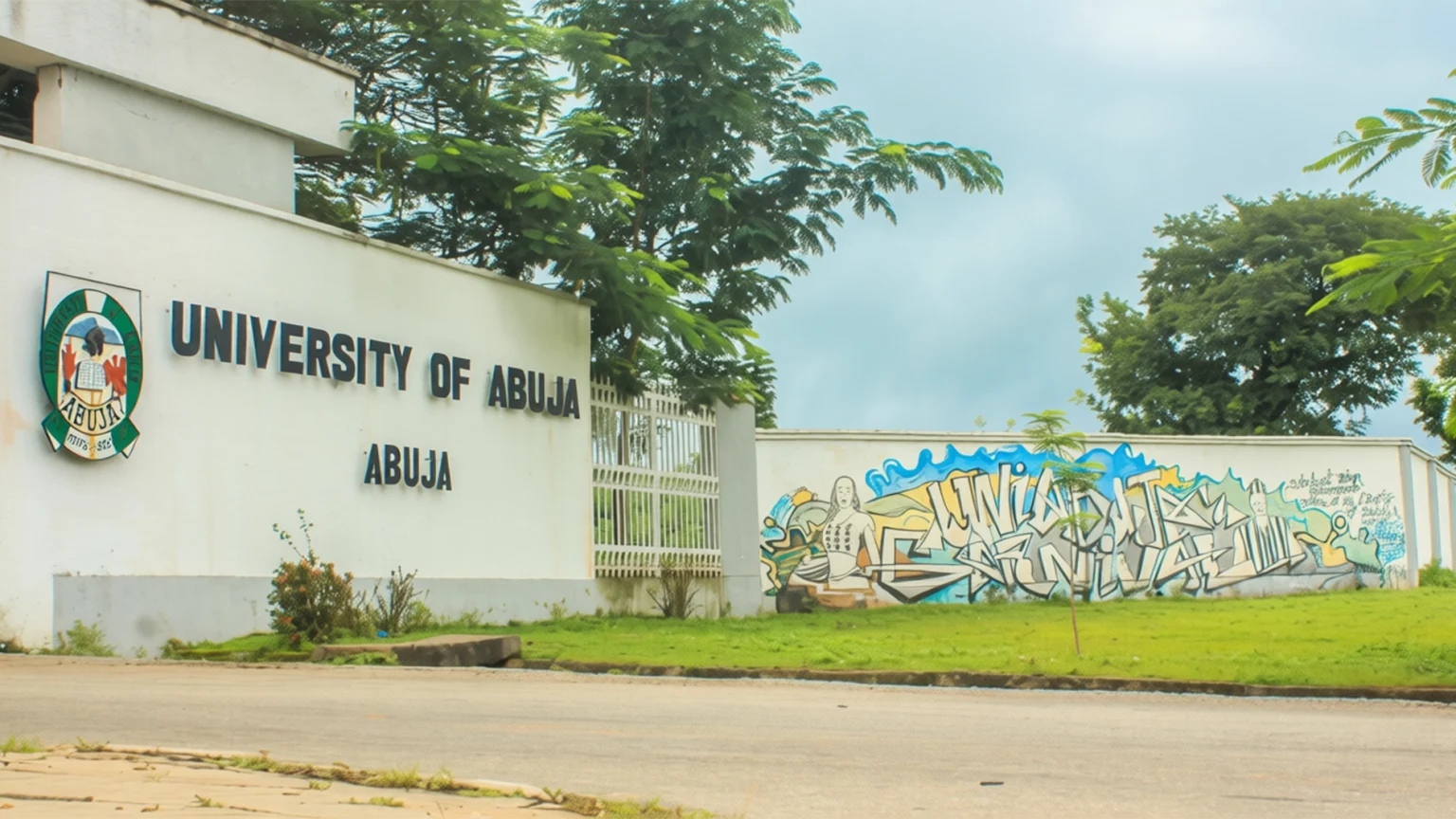
Academic activities were disrupted at the University of Abuja (UniAbuja) on Wednesday after workers and other members of the university community shut the institution’s main gate in protest against the alleged reallocation of its land by the Federal Capital Territory Administration (FCTA).
The protest, organised under the Joint Action Committee (JAC), left students stranded as staff, students and other stakeholders demanded an end to the alleged transfer of portions of the university’s land to private interests.
The protesters accused the Minister of the Federal Capital Territory, Nyesom Wike, and the FCTA of disregarding the rule of law and undermining the institution’s future expansion.
The demonstration involved members of the Academic Staff Union of Universities (ASUU), Senior Staff Association of Nigerian Universities (SSANU), Non-Academic Staff Union of Educational and Associated Institutions (NASU), the Students’ Union Government (SUG) and the university’s alumni association.
The development followed weeks of opposition to the proposed reduction of the university’s original land allocation, with the university community insisting that the disputed property was necessary for its academic and infrastructural development.
Speaking during the protest, ASUU Chairman of the University of Abuja Chapter, Prof. Sylvanus Ugoh, accused the FCTA of circulating what he described as a forged report to justify the alleged reallocation of the institution’s land.
Ugoh questioned the authenticity of the document, claiming that the joint committee cited by the administration held only its inaugural meeting and never reconvened to deliberate or produce any report or recommendations.
He further alleged that an earlier version of the report had been manipulated and forwarded to a former president, who reportedly declined to endorse it.
The ASUU chairman challenged the FCTA to publish the committee’s minutes, members’ signatures and other official records to establish whether the university had agreed to release portions of its land.
Ugoh also alleged that 10 separate land allocations had been made to eight companies, with Certificates of Occupancy reportedly issued in connection with the disputed properties.
He warned that the alleged transfer of university land to private companies could threaten the institution’s future, particularly its capacity to expand academic facilities, research centres, student accommodation and other infrastructure.
According to him, the university needed its original landholding to support future development in agriculture, sports, research and other academic programmes.
Meanwhile, Senator representing the Federal Capital Territory, Ireti Kingibe, condemned the alleged takeover of 7,000 hectares from the university and called on Wike to return the property.
Kingibe expressed solidarity with the protesting students, lecturers and other members of the university community, describing their concerns as genuine and a matter of national importance.
She also raised concerns about students’ accommodation, alleging that rooms originally designed for two occupants were now being shared by between six and 10 students because of limited space for additional hostel construction.
The senator said she had previously raised the land dispute before the National Assembly in 2025, warning that transferring land belonging to a federal institution to private individuals raised serious legal and constitutional questions.
She maintained that universities required sufficient land for expansion and that the disputed property was important to the institution’s long-term development.
The FCTA, however, has defended its decision, maintaining that the reduction of the university’s landholding from 11,824.04 hectares to 4,685 hectares followed an approval granted by a previous administration.
The administration has also questioned the university community’s position on retaining such an extensive land area, while insisting that the minister was implementing an existing government decision.
The land controversy continues to generate tension between the university community and the FCTA, with stakeholders calling for government intervention to resolve the dispute.