

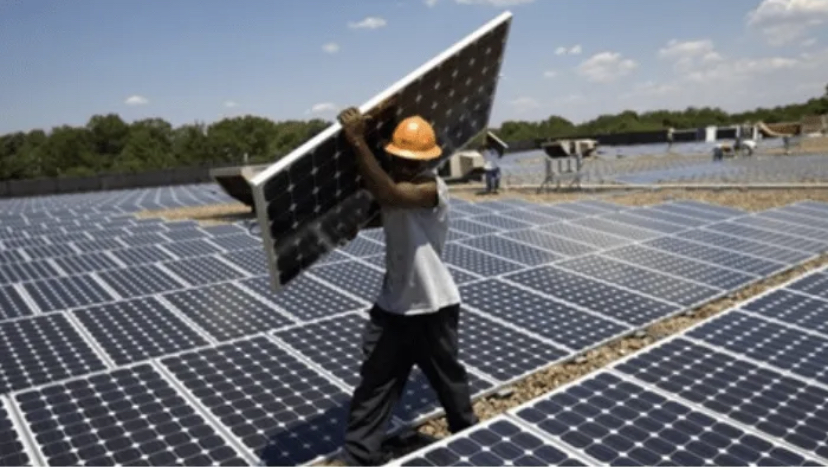

Apart from financing deals in Nigeria’s renewable sector and embracing solar energy for the good of its own business, Stanbic IBTC Holdings Plc is showing other Nigerian banks how to transit from fossil fuel to adoption of cleaner forms of energy.
For years, generators have served as an alternative source of power for Nigerians, as the country experiences unstable and poor power supply. This has led to an increase in the generator budget for many households and businesses, most especially commercial banks.
To solve this challenge, Stanbic IBTC, a member of Standard Bank Group, is creating a policy plan to transit from diesel-powered generators to renewable energy by aiming to run nearly half its 175 business offices in Africa’s largest economy on solar by 2022.
If achieved, Stanbic IBTC will cut diesel costs for generators by about 20percent, the company’s head of sustainability, Omolola Fashesin told Bloomberg.
For most banks, beyond joining the global rush to renewable energy, access to finance is still a major bottleneck for operators in Nigerian markets even as costs of solar equipment continue to soar in the international market.
Responding to the challenge, Fashesin explained, “Stanbic IBTC also plans to set aside $100 million for lending to local companies in the renewables sector over the next three years to help boost adoption of cleaner forms of energy.
“The prospects for solar companies in Nigeria are good but it does require a significant amount of capital,” she said.
“There are opportunities for banks to partner with these companies to provide lending.”
Fashesin noted Stanbic IBTC is in talks with development financial institutions including the International Finance Corp. and the U.S. International Development Finance Corp. for on-lending facilities to Nigerian firms investing in renewables.
“Stanbic IBTC plans to finalize credit for two renewable transactions totaling $40 million, this year,” she said.
For most stakeholders, the initiative is a welcome development in solving issues surrounding climate change and energy poverty which is one of the significant limitations to thriving entrepreneurial growth in Africa’s biggest economy.
Other experts identified relaxing the financing requirement for off-grid developers and creating incentive regimes as some of the ways to foster electrification and localisation of the solar value chain.

Apart from Stanbic IBTC, another bank reducing dependence on diesel and taking a big shot at renewable energy is Union Bank, one of Nigeria’s biggest banks with over 300 offices nationwide.
Two of their offices in Lagos (Ojuelegba as well as Lekki Admiralty) use solar power. It’s hard not to notice over 50 solar panels on the roof of the Ojuelegba branch, one source told TechCabal.
Union Bank switched to clean power sources in 2016 and today, there are 130 branches with solar solutions.
“Our most efficient branch for solar in Lagos is Lekki Admiralty and it’s at 85% efficiency. There’s a system that lets us track efficiency levels across branches,” a source said.
Source: BusinessDay