

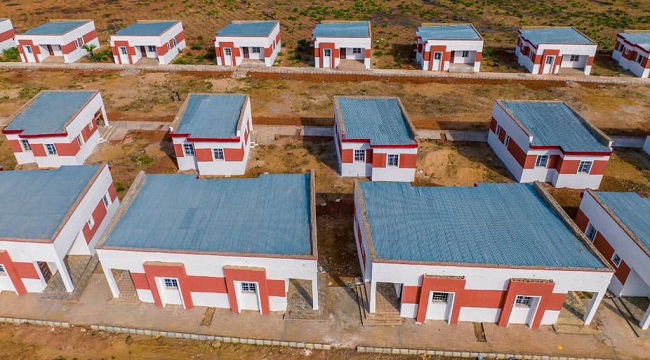
Nigeria needs new ways to deliver affordable homes as high construction costs, low incomes and limited mortgage access continue to keep millions of people out of the formal housing market.
The country is testing several models. These include incremental housing, cooperative schemes, rent-to-own arrangements and public-private partnerships.
The main challenge, however, is scale. Housing experts say Nigeria must move beyond individual projects and build systems that match house prices with what ordinary households can afford.
The Federal Government’s National Housing Data Technical Committee puts Nigeria’s housing deficit at 14.925 million units. Rapid urban growth continues to add pressure to the housing market.
Incremental housing offers another route
The Millard Fuller Foundation has tested an incremental housing model at Grand Luvu, near Abuja.
The Grand Luvu 3B project has 248 housing units. Of these, 177 allow owners to expand their homes as their needs and incomes grow.
This approach allows buyers to start with a smaller home. They can then add rooms when they have the money to do so.
The model may suit households that struggle to secure conventional mortgages. Many workers in Nigeria earn irregular incomes. Others work outside the formal salary system and find it difficult to meet mortgage requirements.
However, affordable construction does not always lead to affordable homeownership.
A 2025 peer-reviewed study of the Grand Luvu project found that interviewed residents earned between N75,000 and N400,000 per month. The study also found that only about 30 per cent of the total units had owner-occupiers. Some buyers rented out their homes instead.
The findings show why housing policy must consider income and finance alongside construction costs.
Cooperatives can improve access
Housing cooperatives offer another path to homeownership.
The Federal Mortgage Bank of Nigeria supports cooperative housing through its Cooperative Housing Development Product. WaterLake Estate in Abuja is one example.
The project has 40 three-bedroom detached bungalows. The Nigeria Police Multipurpose Cooperative Society developed the estate with FMBN financing.
Cooperatives allow members to combine their resources. They can use this collective strength to acquire land, fund construction and seek housing finance.
But cooperatives still face major cost pressures. Land, documentation, construction, project management and loan repayment can all affect the final price of a home.
Rent-to-own reduces the upfront burden
High deposits also prevent many Nigerians from buying homes.
Rent-to-own schemes offer a different approach. They allow households to occupy a property while making payments towards ownership.
The model can reduce the need for a large upfront payment. However, the monthly instalment must still match the household’s income.
A low purchase price alone does not guarantee affordability. Buyers must also be able to meet their monthly payments without putting too much pressure on their household budgets.
Government targets mass housing
The Federal Government is also using large housing projects to increase supply.
The first phase of the Renewed Hope Cities and Estates programme targets 50,000 homes across Nigeria.
The government has announced prices of N8.5 million for one-bedroom homes, N11.5 million for two-bedroom homes and N12.5 million for three-bedroom homes.
Some projects are already under development. The Renewed Hope City at Ibeju-Lekki in Lagos has 2,084 units. The Karsana Renewed Hope City in Abuja has 3,112 units.
Large estates can increase supply quickly. But developers must also provide roads, drainage, water, electricity and transport links.
Without these services, residents may face high transport and living costs. Such costs can reduce the benefit of a low-priced home.
Building costs remain a major problem
Construction costs continue to put pressure on affordable housing.
Cement, steel, imported building products and transport have all added to development costs. As prices rise, fewer households can afford newly built homes.
Experts are therefore calling for greater use of local materials.
Compressed earth bricks are one option. Research in Abuja has found that compressed earth construction can cost less than some conventional building methods.
However, the savings depend on design, labour, location and access to materials.
The industry also needs reliable local supply chains. Materials must meet standards for strength, durability, fire safety and environmental performance.
Experts call for cheaper housing finance
Samuel Odia, Chief Executive Officer of the Millard Fuller Foundation, said Nigeria still lacked enough evidence to determine which affordable housing model works best.
He said incremental housing could prove practical because affordable mortgage finance remains difficult to access.
Odia also identified land shortages, high financing costs and slow land transactions as major barriers to affordable housing.
Debo Adejana, former Vice President, South-West, Real Estate Developers Association of Nigeria (REDAN), also supports incremental housing.
Adejana said Nigeria needs a mortgage system with lower interest rates and repayment periods of at least 15 years.
He also called for government subsidies. In his view, low-priced housing remains difficult to deliver without some form of public support.
Adejana wants the government to reduce land, documentation, design and approval costs. He also supports standard designs for one-, two- and three-bedroom homes.
Standard designs could help developers produce building components in larger quantities. This could lower construction costs and improve delivery speed.
Housing needs a combined approach
Dr Yemi Adelakun, Chief Executive Officer of NISH Affordable Housing Ltd, said Nigeria needs several housing models.
He pointed to cooperative, incremental, community-led and public-private-people partnerships.
Adelakun also called for cheaper housing finance, land equity and a revolving social housing fund. He proposed housing loans at interest rates of no more than three per cent.
He also wants government to provide infrastructure and offtake guarantees. These measures, he said, could encourage developers and finance providers to build more affordable homes.
Prof. Timothy Nubi, Founder and Director of the Centre for Housing and Sustainable Development at the University of Lagos, also supports a mix of solutions.
Nubi said Nigeria must expand mortgage finance and allow buyers to repay housing loans over 20 to 30 years.
Longer repayment periods can reduce monthly payments. They can therefore make homeownership more realistic for households that cannot afford to pay the full cost of a house upfront.
Nigeria must build for affordability
Nigeria’s housing problem cannot be solved by building more houses alone.
The country needs cheaper land, faster approvals, better infrastructure and stronger housing finance. It also needs local production of building materials and designs that reduce construction costs.
Most importantly, housing prices must reflect household incomes.
The experience of incremental housing, cooperatives, rent-to-own schemes and large government estates shows that Nigeria has several possible routes.
The next challenge is to connect these models with the finance, land and infrastructure systems needed to take them from individual projects to large-scale housing delivery.