

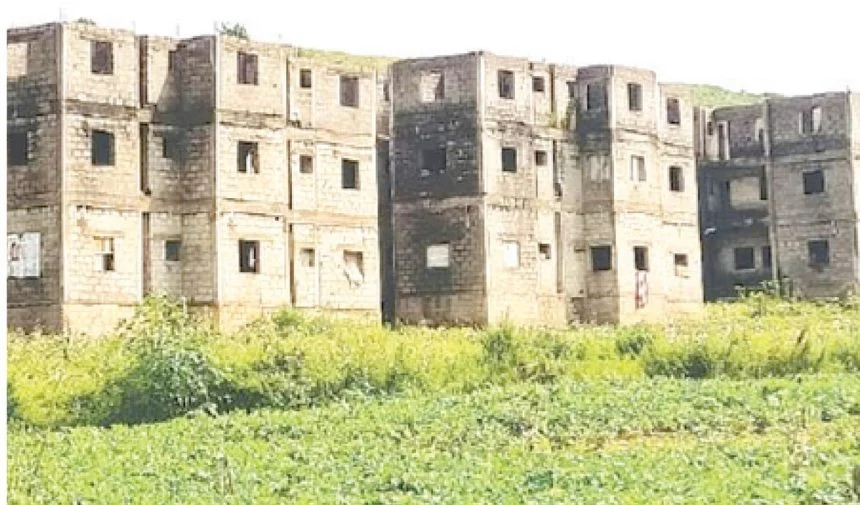
Housing Experts Urge Tinubu to Complete Abandoned Projects Nationwide
Housing experts have called on President Bola Ahmed Tinubu to prioritise the completion of viable abandoned housing and public building projects across Nigeria, citing the billions of naira tied up in unfinished developments while millions of citizens struggle to find decent homes.
The experts said completing existing projects that remain economically and structurally viable could increase housing supply faster and at a lower cost than repeatedly launching new schemes.
The call was made by the President of the Association of Housing Corporations of Nigeria, Eno Obongha, and the Executive Director of the Housing Development Advocacy Network (HDAN), Festus Adebayo, as Nigeria marked its 66th Independence Anniversary.
They argued that the country needed to move beyond announcements and groundbreaking ceremonies towards measuring actual housing delivery.
The experts called for a comprehensive review of projects initiated by federal and state governments, housing institutions and publicly supported intervention programmes.
According to them, the review should establish the number of projects completed, those occupied by beneficiaries, those abandoned or stalled, and the extent to which completed homes remain affordable to their intended occupants.
Adebayo said the country needed to ask difficult questions about the performance of public housing programmes.
He questioned how many homes governments and public housing institutions had promised, how many had actually been completed, how many were occupied and how many had been abandoned.
Nigeria’s Housing Deficit and Abandoned Investments
Nigeria faces an estimated housing deficit of about 14.925 million units, while approximately 15.2 million existing homes are classified as structurally inadequate.
Adebayo said abandoned public housing projects represented more than unfinished buildings. They also meant public funds locked into incomplete developments, infrastructure deteriorating over time and homes that could otherwise provide accommodation for families.
He called for an independent nationwide audit to classify abandoned projects into three categories: those that could be completed immediately, those requiring restructuring or new partnerships, and those that were no longer economically or structurally viable.
The proposed assessment, he said, would help authorities determine the most practical way to recover public investments and increase the supply of habitable homes.
Billions Allocated to Projects Left Unfinished
The call comes amid concerns over the implementation of government-funded projects across the country.
Tracka, an accountability initiative of BudgIT, reported that projects covered by its monitoring had received allocations of approximately ₦29 billion. Of this amount, about ₦8 billion had been disbursed to projects that were subsequently abandoned.
Another ₦7.6 billion was allocated to projects that were never started.
Tracka Head, Joshua Olufemi, said the organisation had examined 2,760 projects out of approximately 24,443 projects being monitored.
The figures have raised questions about project supervision, the use of public funds and the mechanisms available to ensure that budgetary allocations translate into completed infrastructure.
For housing projects, the consequences extend to prospective homeowners who may wait years for developments to be completed, while the cost of construction and the deterioration of unfinished structures make eventual delivery more difficult.
Lagos Identifies Hundreds of Abandoned Buildings
In Lagos State, the Lagos State Building Control Agency (LASBCA) identified 759 abandoned buildings across the state as of June 20, 2026.
The agency’s General Manager, Florence Omolola Gbaye, warned that some of the structures posed security, environmental and public-health risks.
The findings underline the need to assess abandoned buildings not only in terms of their potential for redevelopment but also in relation to public safety.
Structures left unattended for long periods can deteriorate, while their surroundings may become unsafe for residents and neighbouring communities.
The situation also reinforces calls for authorities to determine which buildings can be restored, which require major intervention and which may need to be dealt with because of structural or safety concerns.
Experts Raise Concerns Over Building Safety
The Building Collapse Prevention Guild (BCPG) has also urged the Federal Government to rehabilitate the abandoned Old Federal Government Secretariat and adjoining towers in Lagos.
The guild cited structural deterioration, increasing restoration costs and safety concerns associated with the buildings.
Data from the BCPG indicate that Nigeria has recorded at least 679 building collapses, resulting in more than 1,639 deaths. Lagos accounts for between 50 and 60 per cent of reported incidents.
The figures have renewed attention on construction quality, building control and the enforcement of safety standards.
Adebayo stressed that efforts to provide affordable housing must not come at the expense of construction quality.
He called on the authorities to hold contractors, developers, consultants and supervising officials accountable where structural defects and other failures have been established.
He said housing affordability should not be used to justify substandard construction, adding that homes must be safe and suitable for occupation.
Completed Housing Projects Show Progress
Despite the challenges, Adebayo acknowledged some housing delivery achievements.
Among the examples he cited were 129 completed three-bedroom bungalows delivered under the Federal Mortgage Bank of Nigeria’s Rent-to-Own Scheme at Nasarawa Technology Village in August 2026.
He also referenced the 2,084-unit Lagos Renewed Hope City project at Ibeju-Lekki.
However, he maintained that new developments should be accompanied by a systematic effort to recover viable abandoned housing projects.
According to him, addressing unfinished estates could help make better use of existing investments and increase the number of homes available to Nigerians.
The experts argued that a nationwide review would allow the government to establish clear priorities, identify implementation failures and determine where additional funding or partnerships could lead to completion.
HDAN Proposes National Housing Project Dashboard
As part of efforts to improve transparency, HDAN proposed the creation of a National Housing Project Performance Dashboard.
The proposed platform would allow Nigerians to track the progress of public housing projects, including funding, completion timelines, affordability, allocation and occupancy.
Adebayo said the initiative would help the public distinguish between projects announced by government and homes actually delivered to beneficiaries.
Such a system, he argued, would make it easier to monitor implementation, identify delays and assess whether public resources were producing the intended results.
He urged the government to shift its focus from announcing housing intentions to measuring completed delivery.
“A groundbreaking is not a house. An allocation on paper is not homeownership. A budget provision is not a completed estate,” Adebayo said.
He called on the government to ensure that public housing expenditure results in affordable, habitable homes that Nigerians can occupy.