

Nigeria’s commercial property market is entering a new phase as major businesses increasingly assess office space by more than rental cost, with infrastructure, security, connectivity and operational readiness becoming important factors in location decisions.
The change is particularly relevant to multinational corporations and large indigenous companies that require workplaces capable of supporting complex operations. Rather than taking an empty office and managing every stage of the fit-out themselves, some occupiers are showing greater interest in spaces that can be adapted to their needs and brought into use more quickly.
The development does not signal the end of traditional office leasing or flexible workspaces. Instead, it points to a more varied corporate property market in which businesses can combine dedicated offices with flexible arrangements depending on their workforce and operational requirements.
Global workplace trends support this shift. Research from Cushman & Wakefield identifies agility, premium amenities and cost efficiency as major considerations behind the continued use of flexible office solutions.
For larger organisations, however, flexibility can mean having control over a dedicated workplace rather than simply sharing facilities with other tenants.
Security, corporate identity, regulatory compliance, specialist equipment and business continuity can all influence the suitability of a workspace. These requirements can make a fully shared environment less practical for companies whose operations involve sensitive information, large teams or specialised infrastructure.
From empty floors to operational workplaces
The changing expectations are also affecting how developers approach commercial property.
A conventional office lease can leave a tenant responsible for coordinating architects, engineers, ICT providers, furniture suppliers, contractors and facilities managers before staff can begin working from the premises.
That process can take considerable time and expose companies to construction delays, coordination problems and additional project costs. For businesses expanding into a new city or establishing a regional headquarters, the ability to move from signing an agreement to becoming operational can therefore be an important consideration.
This is helping to strengthen the appeal of managed and serviced office models. In Nigeria, industry reporting in 2026 has pointed to increasing demand for managed workspaces as companies seek shorter commitments, lower upfront costs and greater flexibility.
The implications extend beyond office tenants. Developers now face pressure to deliver buildings that provide the infrastructure and services required by modern companies, rather than relying solely on location and floor area to attract occupiers.
Abuja provides an example
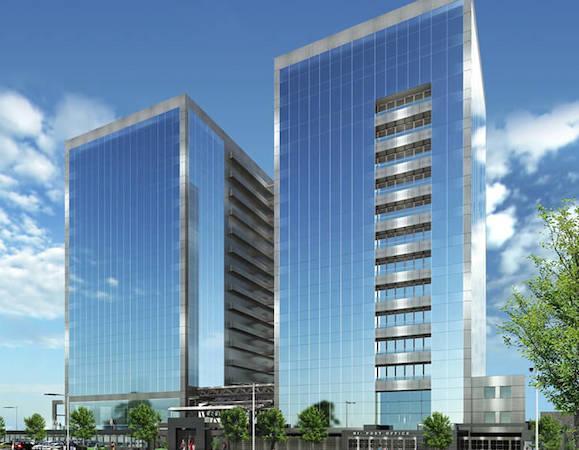
The World Trade Center Abuja illustrates how this model is developing in the Nigerian capital.
The development currently advertises 33,180 square metres of office space within its Central Business District complex, alongside 120 executive residences and a full-service clubhouse. Its listed corporate occupiers include Microsoft, Citibank, S&P Global, General Electric and Seplat.
The development also highlights infrastructure such as on-site power capacity, fibre connectivity and controlled access as part of its commercial proposition.
The presence of international companies is also reflected in individual corporate announcements. S&P Global Commodity Insights announced in October 2025 that it would establish an Abuja office at the World Trade Center complex, describing the move as part of its commitment to serving clients and engaging with policymakers and the regional commodities industry.
S&P Global’s current office directory lists its Abuja location at the World Trade Center Building in the Central Business District.
What it means for Nigeria’s property market
The evolution of corporate office demand comes as Nigeria’s commercial property sector faces changing occupier preferences.
Recent reporting on Lagos, for example, indicates a growing divide between prime Grade A offices that continue to attract demand and older Grade B properties facing higher vacancy levels.
This suggests that businesses are becoming more selective about the quality and functionality of office environments.
For developers and investors, the message is increasingly clear: commercial property is being judged not only by its address or size, but by the extent to which it can support business operations.
Reliable power, telecommunications, security, efficient facilities management and adaptable office layouts can influence the value of a commercial development to prospective tenants.
For Nigeria’s urban centres, the trend also reinforces the importance of infrastructure-led development. As companies establish offices in Abuja, Lagos and other commercial hubs, the quality of surrounding infrastructure and business districts will remain closely connected to demand for modern commercial property.
The office market is therefore not simply moving away from renting. It is moving towards a broader definition of what companies expect to receive for their occupancy costs. For property developers, investors and facility operators, understanding that shift could be critical to remaining competitive as corporate workplace requirements continue to evolve.