

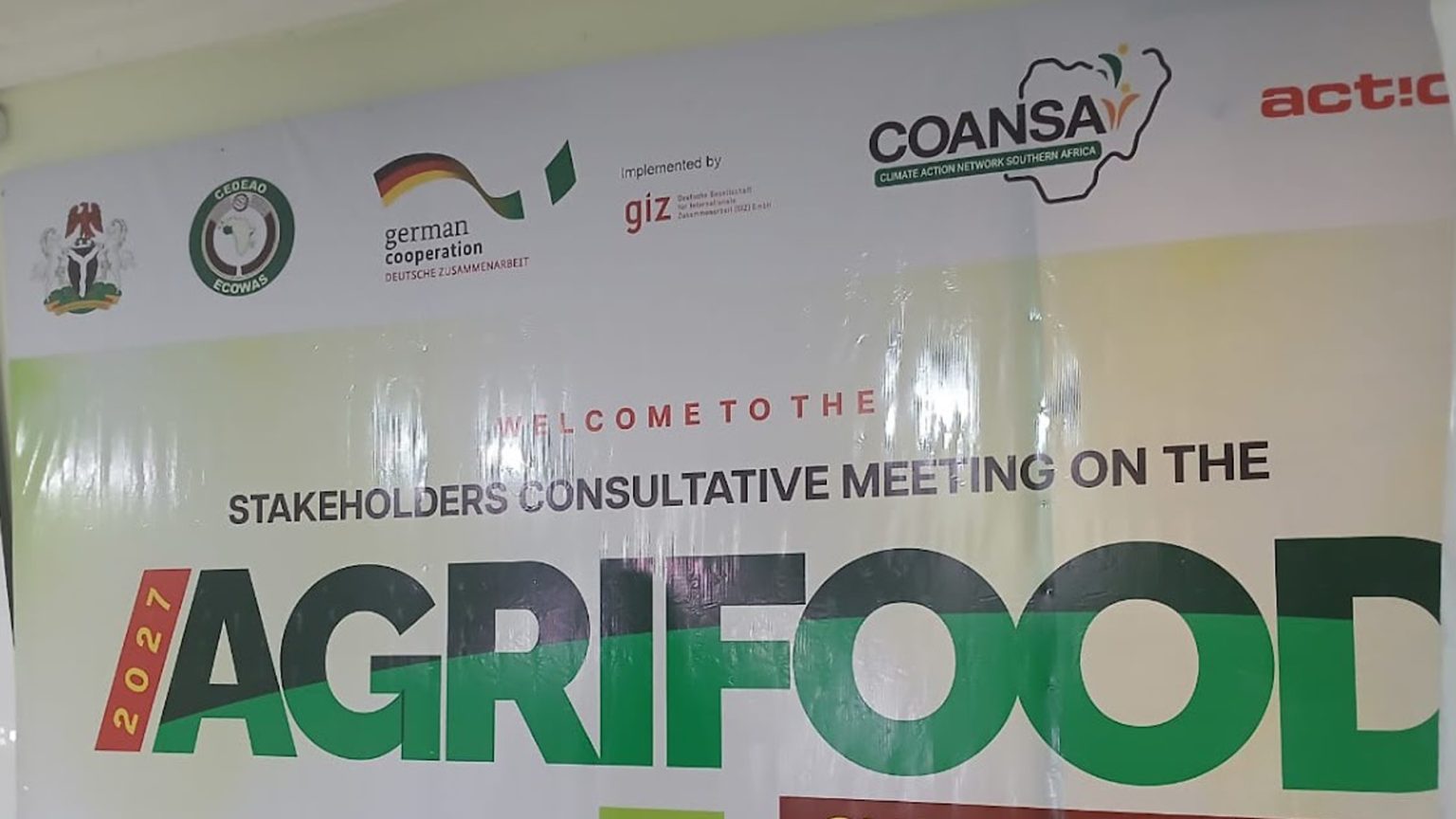
Agriculture and food-sector stakeholders have called on the Federal Government to increase public investment in Nigeria’s agrifood system to ₦10.5 trillion in the 2027 budget, warning that inadequate funding and delays in releasing approved funds are weakening efforts to improve food security and create jobs.
The recommendation followed a three-day National Stakeholders Consultative Meeting on the 2027 AgriFood Systems Budget held in Lagos.
The meeting brought together representatives from government agencies, the National Assembly, research institutions, universities, civil society organisations, farmer groups, development partners, the private sector and the media.
The event was organised by ActionAid Nigeria, the GIZ Global Programme Sustainable Agricultural Systems and Policies Nigeria, the Federal Ministry of Budget and Economic Planning, the Federal Ministry of Agriculture and Food Security, and the Department of Agriculture and Rural Development of the ECOWAS Commission.
Nigeria Falls Short of Agriculture Spending Target
Participants expressed concern that Nigeria’s public spending on agriculture remains below its regional and continental commitments.
According to the meeting’s communiqué, combined agricultural spending by the Federal Government, the 36 states and the Federal Capital Territory was estimated at 4.58 per cent in 2026.
That figure remains below the 10 per cent target associated with Nigeria’s Comprehensive Africa Agriculture Development Programme (CAADP) commitments and the Kampala Declaration.
The stakeholders argued that the funding gap limits the government’s ability to address challenges across food production, processing, storage and distribution.
Delayed Releases Hurt Farmers
The participants also raised concerns about the implementation of agricultural budgets at the state level.
They said actual capital budget implementation for agriculture averaged about 50 per cent between 2023 and 2025 across the states.
The stakeholders warned that delays in releasing approved funds have a particularly serious effect on agriculture because farming follows specific seasons. When funds arrive late, farmers and government programmes can miss planting periods and face rushed procurement.
They said such delays can reduce the value of public spending and limit the impact of agricultural programmes on productivity and food security.
Focus Shifts From Allocations to Results
The meeting called for agricultural budgets to be judged by their results rather than simply by the amount approved or released.
Stakeholders said government should track indicators such as agricultural productivity, farmer income, employment, food prices, nutrition, climate resilience and poverty reduction.
Evidence presented during the meeting suggested that full implementation of approved federal and state agricultural and livestock capital budgets could generate about 3.5 million direct quality jobs.
Of that figure, approximately 2.1 million jobs could come from federal-level implementation, while another 1.4 million could emerge across the states and the FCT.
Stakeholders Seek Broader Agricultural Investment
Participants also questioned the structure of some agricultural budgets. They raised concerns about the inclusion of constituency projects that do not directly fall within the core responsibilities of agrifood ministries.
They called for a broader investment strategy that goes beyond fertiliser distribution.
The stakeholders recommended greater spending on agricultural extension services, mechanisation, irrigation, climate-smart farming, agroecology and research. They also highlighted storage, food processing, market access and agricultural data systems as areas requiring stronger investment.
Fertiliser Spending Raises Concerns
The communiqué also questioned the allocation of the National Agricultural Development Fund.
According to figures cited by civil society organisations at the meeting, as much as 98 per cent of the fund’s 2026 capital allocation may have been directed towards fertiliser programmes.
Stakeholders argued that such concentration does not reflect the fund’s broader statutory responsibilities. They called for a more balanced approach that supports different stages of the agricultural value chain.
Climate and Insecurity Add Pressure
The participants also highlighted climate change and insecurity as growing risks to Nigeria’s food system.
Flooding, drought and rising temperatures can disrupt agricultural production and increase pressure on farmers and food prices. Insecurity can further restrict access to farmland and markets.
The stakeholders therefore called for climate resilience and agricultural security to form part of broader budget planning.
For Nigeria’s housing and urban development sector, the issue also carries wider implications. Food prices directly affect household purchasing power, while rural productivity, employment and migration influence demand for housing in cities. Stronger investment across the agrifood value chain could therefore support not only food security but also household incomes and more sustainable urban growth.
The call for a ₦10.5 trillion agrifood allocation in 2027 reflects growing pressure on policymakers to move beyond budget announcements and focus on timely implementation, measurable results and investment across the full food system. For the sector to contribute more effectively to jobs, incomes and national development, stakeholders say funding must reach programmes when farmers and businesses need it most.