

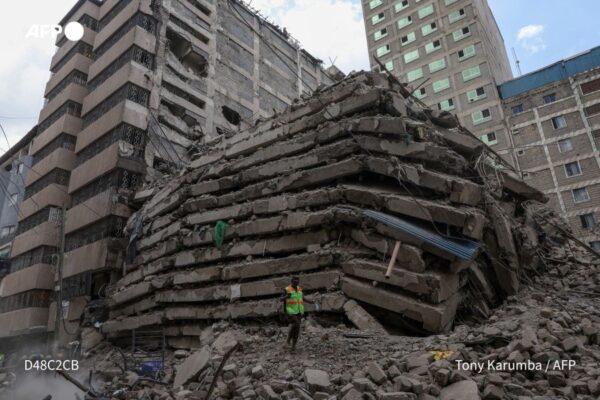
A multi-storey building under construction collapsed in Nairobi, Kenya, on Friday, raising fears that several people may be trapped beneath the rubble.
The building, reportedly about 18 storeys high, collapsed in Eastleigh, a densely populated area of the Kenyan capital known for its residential and commercial developments.
Videos circulating online showed the structure crumbling in a cloud of dust, leaving a large pile of debris as emergency responders rushed to the scene.
Rescue efforts initially faced challenges because the building was squeezed between other high-rise structures, restricting access to the site.
Police said rescuers had pulled a woman from the rubble and could hear another person believed to be trapped beneath the debris.
“There are lots of people trapped here,” Bibiye Mahmoud, president of the Institution of Engineering Technology of Kenya, told Agence France-Presse (AFP) at the scene.
The number of people trapped and the full extent of the casualties had not been established at the time of reporting.
Engineers Raise Concerns Over Building Standards
Mahmoud criticised the enforcement of construction standards, saying contractors and engineers should ensure that building work follows professional requirements.
“The contractors and the engineers are supposed to ensure that the works are followed by professionals. But most are not. This is why we are seeing these catastrophes… There is no accountability,” she said.
A report by Kenya’s National Building Inspectorate found that 87 per cent of buildings audited nationwide in the previous year failed to meet standards or lacked the required approvals.
Nairobi Governor Johnson Sakaja said the collapsed building did not have an occupation certificate, raising further questions about regulatory compliance.
“Our concern is to save lives,” Sakaja told reporters, adding that the absence of the certificate had potentially cost lives.
An occupation certificate is an official document confirming that a building meets applicable requirements for lawful occupation.
John Ogallo, vice-president of the Institution of Engineers of Kenya, said there had reportedly been warning signs before the collapse.
“People here are saying distresses were observed, like cracks,” he told reporters.
Ogallo warned that using substandard construction materials could create serious safety risks.
Rescue Operations Face Access Challenges
Emergency responders continued efforts to search the rubble and determine whether other people remained trapped.
The building’s location between neighbouring high-rise structures complicated access for rescue teams, according to reports from the scene.
Local media also reported looting shortly after the collapse, which occurred around lunchtime. AFP reported that police used tear gas to disperse crowds gathered near the site.
Authorities had yet to establish the full circumstances of the collapse, including whether construction defects, regulatory failures or other factors contributed to the incident.
Nairobi Faces Growing Building Safety Concerns
The collapse has renewed concerns about construction safety in Nairobi, where rapid urban growth has fuelled the development of high-rise residential and commercial buildings.
Eastleigh, in particular, has experienced significant construction activity and is known for its busy markets and large Somali community.
A report by the Kenya Institute for Public Policy Research and Analysis recorded 86 building collapses in Nairobi between 2009 and 2019, resulting in an estimated 200 deaths.
Statistics from Kenya’s national statistics bureau showed that the number of buildings completed annually in Nairobi increased from 20,025 in 2022 to 25,090 in 2023.
Concerns have also been raised about corruption and the alleged circumvention of construction regulations, which can undermine building safety.
In September 2022, five people were killed when a six-storey building collapsed in a town on the outskirts of Nairobi.
Another major disaster occurred in April 2016, when 49 people died after a six-storey apartment building collapsed in the northeastern part of the capital following days of heavy rain, flooding and landslides.
The latest collapse has renewed calls for stronger oversight of construction projects and enforcement of building regulations.
Rescue teams remained focused on locating anyone trapped beneath the rubble as authorities worked to establish the circumstances surrounding the incident.