

A Nigerian-born landlord in the United States, Olufemi Falade, reportedly owes more than $450,000 in outstanding fines, unpaid taxes and water bills and has appeared on New York City’s Worst Landlord Watchlist six times in the last decade.
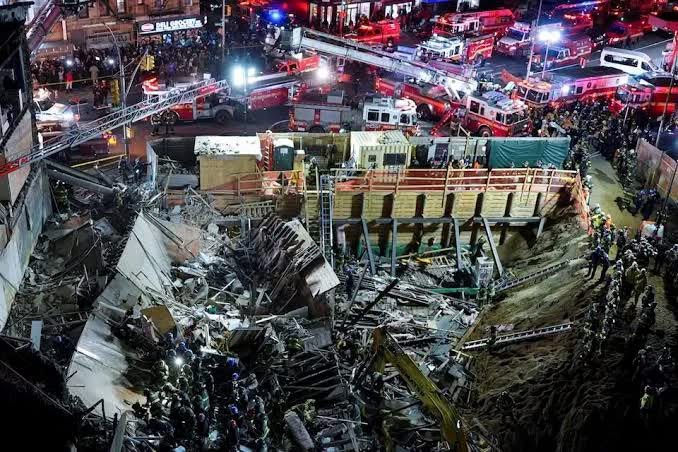
Falade was identified by New York City Public Advocate, Jumaane Williams, as the registered head officer of 1321 Flatbush Avenue, Brooklyn, where a three-storey apartment building collapsed on Wednesday, November 11, killing eight people.
In a statement issued on Saturday, Williams said Falade had featured on the city’s annual Worst Landlord Watchlist six times between 2017 and 2024, citing his record of property maintenance violations.
The landlord was ranked 93rd in 2017, 66th in 2019, 50th in 2020, 68th in 2021, 100th in 2022 and 95th in 2024.
Williams said landlords with poor maintenance records routinely prioritised profits over residents’ welfare, warning that negligence could put lives at risk.
“While we don’t yet know exactly what caused the collapse that claimed the lives of our neighbours and devastated our city, Olufemi Falade has a documented record of failing to maintain properties,” he said.
He added that the city’s Department of Buildings was investigating the collapse, including the condition of the structure and construction activities around the site.
“It is essential that any negligence which may have contributed be identified, everyone responsible held accountable, and preventative action taken to save lives in the future,” Williams said.
Landlord Owes More Than $450,000
A report by the New York Post, citing a review of city records, said Falade owed more than $450,000 in fines, unpaid taxes and water bills.
The report said the landlord owed $170,000 in fines issued by the Department of Buildings in 2019 over improperly displayed signs.
He also reportedly owed $114,945 in outstanding water bills accumulated over several years and $113,526 in property taxes dating back to 2021.
Additional liabilities included $49,269 owed to the Internal Revenue Service in unpaid personal federal income taxes, according to a 2010 lien, and $4,316 in New York State personal income taxes.
The newspaper reported that the 96-year-old building was purchased by Falade in 1999 through an entity known as Femi Realty Corp.
In November 2024, he reportedly transferred ownership to another company under his control, Isolag Realty Corp, signing the deed as both seller and buyer without any money changing hands.
Building Had 98 Outstanding Violations
Records from New York City’s Department of Housing Preservation and Development reportedly showed that the building had 98 open violations before its collapse.
The violations included a leaking roof, defective doors, bedbug infestations and exposed electrical wiring.
According to the New York Post, records showed that complaints and violations concerning the leaking roof dated as far back as 1976, with further notices issued through 2026.
Falade also had a previous record of legal action over property maintenance.
In 2006, he was reportedly sentenced to 12 days in jail and fined $50,000 for civil contempt after failing to address more than 1,800 violations involving 12 Brooklyn buildings he owned at the time.
The violations included vermin infestations, exposed electrical wires and leaking pipes.
Legal experts cited by the New York Post said transferring properties between companies controlled by the same landlord does not automatically eliminate outstanding debts and liabilities.
Investigation Into Building Collapse Continues
The three-storey apartment building in Brooklyn’s Flatbush neighbourhood collapsed at about 4pm on Wednesday, November 11, plunging into an adjoining construction site where excavation work was underway.
Eight people were killed in the incident.
New York City authorities have launched an investigation to determine the cause of the collapse and whether construction activities or maintenance failures contributed to the tragedy.
Public Advocate Williams said the investigation must establish responsibility and identify measures to prevent similar incidents.
Although Falade’s maintenance record has attracted scrutiny following the collapse, authorities have yet to establish that negligence on his part caused the building to fall.