

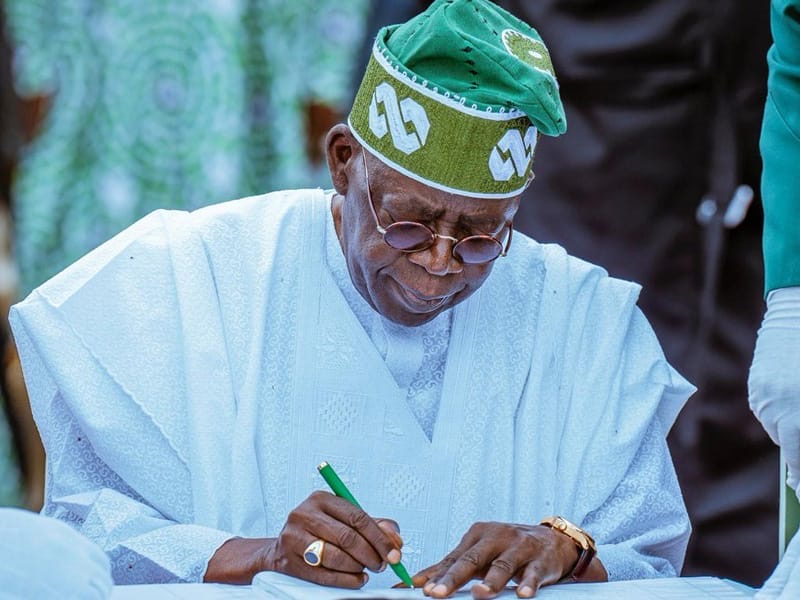
President Bola Tinubu has asked the Senate to approve a proposed external borrowing plan of $20.51 billion and €1.45 billion to address funding gaps under the Federal Government’s 2026–2027 supplementary borrowing plan.
The request was conveyed in a letter read by Senate President Godswill Akpabio during plenary on Tuesday, October 27, 2026.
In the letter, Tinubu urged the National Assembly to consider and approve the proposal promptly, saying the funds would help the government meet its obligations to Nigerians and finance critical sectors of the economy.
“I submit here, the attached Federal Government 2026–2027 Supplementary External Borrowing Plan for consideration and early approval of the National Assembly to ensure prompt implementation of our projects,” the President stated.
Tinubu said the proposed programmes and projects had undergone technical and economic evaluations, with consideration given to their expected contributions to Nigeria’s socioeconomic development.
He added that the financing would support initiatives aimed at creating jobs, promoting skills acquisition and entrepreneurship, reducing poverty and strengthening food security.
The proposal remains subject to legislative scrutiny and has not yet received approval through the process outlined in the presidential letter.
Senate Refers Borrowing Request To Committees
Following the presentation of the letter, Akpabio referred the request to the Senate Committee on Local and Foreign Debts, working with the committees on Appropriation and Finance.
The committees were directed to examine the proposal and report back to the Senate within one week.
Akpabio said aspects of the borrowing plan had previously been considered in the budget, while an external borrowing plan had also received legislative approval during an earlier period.
The review is expected to examine the proposed financing, its intended uses and its relationship with existing budgetary provisions.
However, the details provided in the reported letter did not identify the individual projects to be financed, the proposed lenders, interest rates, repayment periods or conditions attached to the facilities.
These details will be important in assessing the financial implications of the proposed borrowing and its potential contribution to the government’s development objectives.
Tinubu’s Previous External Borrowing Requests
The latest request follows several external financing proposals submitted by the Tinubu administration to support budget implementation, infrastructure development and debt refinancing.
In May 2025, the President sought legislative approval for an external borrowing framework covering the 2025–2026 period. The proposal included $21.5 billion, €2.194 billion, 15 billion Japanese yen and grants worth $65 million.
The Senate subsequently approved the earlier borrowing plan in July 2025 after consideration by its Committee on Local and Foreign Debts.
In October 2025, the administration also sought approval for an additional $2.3 billion external financing package to support the 2025 budget and refinance maturing Eurobonds.
In March 2026, Tinubu requested approval for separate external financing arrangements, including a proposed facility of up to $5 billion from First Abu Dhabi Bank and a $1 billion loan facility for the rehabilitation of the Lagos Port Complex and Tin Can Island Port.
The latest proposal specifically concerns the Federal Government’s 2026–2027 supplementary external borrowing plan and remains subject to the legislative process.
Debt Sustainability And Accountability Concerns
Nigeria’s borrowing requirements continue to raise questions about debt sustainability, effective project implementation and transparency in the use of public funds.
External borrowing can provide resources for infrastructure, public services and economic development when government revenue is insufficient to meet expenditure needs.
However, loans create future repayment obligations, including principal and interest payments, which must be accommodated in subsequent budgets.
The benefits of any borrowing plan therefore depend on the financing terms, the quality of the projects selected and their ability to deliver measurable economic and social gains.
For the proposed plan, the government’s stated objectives include job creation, skills development, poverty reduction and improved food security.
Achieving those objectives will require clear implementation arrangements, effective oversight and accountability for how the borrowed funds are spent.
The Senate committees’ review will help determine the proposal’s scope and the financial obligations that could arise from it.
For now, the request has been referred to the relevant committees, which are expected to submit their findings within one week before further consideration by the Senate.