

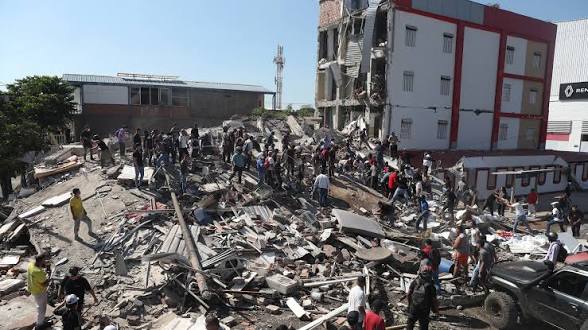
A powerful earthquake that struck western Colombia has left thousands of families facing the loss of their homes, with the scale of destruction raising fresh concerns about building safety and resilient housing in earthquake-prone communities.
The magnitude 7.4 earthquake struck early Monday, August 10, causing widespread destruction across several parts of the country. Rescue operations are still underway as emergency teams search collapsed buildings for survivors.
The latest reports indicate that more than 9,550 homes have been destroyed, while more than 30,300 families have been affected by the disaster.
The damage has been particularly severe in cities and communities across the western and coffee-growing regions, including Cali, Pereira and Manizales.
In Cali, more than 56 buildings have reportedly collapsed, with the destruction contributing to a significant number of deaths and injuries. Rescue workers continue to search through damaged structures as families wait for news of relatives who may still be trapped.
Beyond the immediate loss of lives, the earthquake has created a major housing and reconstruction challenge. Thousands of households now face the prospect of temporary accommodation, repairs or complete rebuilding of their homes.
The disaster has also highlighted the importance of earthquake-resistant construction and effective building standards, particularly in areas with known seismic risks.
Research into seismic risk in Colombia has previously identified Bogotá, Medellín and Cali among major urban centres exposed to earthquake hazards. Studies have also examined the vulnerability of residential buildings, including structures built with unreinforced masonry.
The issue is particularly important for lower-income households, where homes may have been built incrementally or without the structural safeguards required for stronger earthquake resistance. Research on resilient housing in Colombia has highlighted the vulnerability of inadequately reinforced masonry construction and the need for safer building practices.
As rescue operations continue, attention is gradually turning towards the enormous task of reconstruction.
For the Colombian government, one of the immediate priorities will be providing emergency shelter for displaced families. Longer term, authorities will face the challenge of rebuilding homes and public infrastructure while ensuring that reconstructed buildings are safer and better able to withstand future earthquakes.
The disaster therefore goes beyond the destruction of individual buildings. It raises fundamental questions about housing resilience, construction standards, urban planning and how communities can protect lives and property against future natural disasters.
With thousands of families now affected, the Colombian earthquake is a stark reminder that a home is not truly secure simply because it has walls and a roof. The quality of its construction, the safety of its location and the resilience of the wider community can determine whether that home survives a disaster.